The V3 Quant Engine Whitepaper
An architectural breakdown of the transition from raw expected points optimization to a hedge-fund grade, behaviorally constrained portfolio optimizer.
1. The Problem with "Expected Points" (xP)
In the casual FPL community, managers build their teams around Expected Points (xP). However, at the elite quantitative level, optimizing purely for xP—or manually inflating xP based on a player's popularity—is mathematically flawed.
Prior models attempted to create "Safe" squads by taking a highly-owned player's xP and multiplying it by an Expected Ownership (EO) factor. This effectively lied to the linear programming solver, tricking it into believing popular players would physically score more goals.
The result was an engine that confused popularity with mathematical efficiency, leading to over-investment in expensive template players and a collapse in true differential discovery.
2. The New Architecture: Layered Optimization
The FPL Horizon V3 Engine abandons xP multipliers entirely. It operates on a dual-layered Hedge Fund architecture, separating the "Truth Engine" from the "Risk Overlay."
The objective function of the LP Solver is now completely isolated from ownership statistics. It seeks only to maximize pure, risk-adjusted Expected Utility (EV).
Rank protection is no longer smuggled into the player's score. Instead, it is enforced via strict structural constraints within the LP matrix, forcing the solver to purchase "insurance" without corrupting the EV math.
3. Strategy Modes Redefined
By moving behavioral logic into strict constraints, the engine's Strategy Modes now have distinct, mathematically pure identities.
SAFE MODE acts as a positioning system. It acknowledges the true mathematical cost of players like Salah or Palmer, but forcibly retains them to satisfy the portfolio's safety mandate, guaranteeing you never fall out of the elite pack.
RISKY MODE is a pure variance capture system. It strips away all ownership constraints, allowing the solver to ruthlessly exploit pricing inefficiencies and hunt for asymmetric upside to close massive rank deficits.
VALUE MODE focuses strictly on Points-Per-Million (PPM), allowing you to build massive squad value for future Wildcards.
4. The Mathematical "Cost of Insurance"
Because the engine is now mathematically honest, you can calculate the exact cost of protecting your rank in any given gameweek.
If the RISKY squad projects to score 54.1 xP, but the SAFE squad projects to score 52.0 xP, the engine is explicitly telling you that the "insurance premium" required to cover heavily-owned assets is exactly 2.1 Expected Points.
Winning FPL is not simply an optimization problem—it is a Positioning and Variance Capture System. The V3 Engine gives you the exact mathematical framework to execute both flawlessly.
5. The 3-Fuel Engine Architecture
Data quality is the foundation of any quantitative model. The V3 Engine introduces a tri-source modular fuel architecture, allowing managers to dynamically select their underlying projection engine based on the phase of the season.
Scrapes real-time expected points from trusted community projection engines. Pre-bakes fixture difficulty and set-piece roles. Ideal for early-season gameweeks (GW1–GW4) before single-season sample sizes mature.
Powered by Evolutionary Strategies (ES-v001). Trains custom weights on underlying metrics (xG, xA, xGI3, xGI5, home/away splits, opponent defense) stored in the internal feature store. Dominates from GW5 onwards as underlying stats stabilize.
Direct REST integration with the official Premier League API. Serves as a conservative baseline and automated fallback pipeline during cloud or scraping disruptions.
6. Probabilistic Distributions & Portfolio Covariance
Standard FPL tools treat player points as independent random variables. In reality, football points are highly correlated: a goal by Haaland is often accompanied by a De Bruyne assist, while a clean sheet wipeout hurts every defender on the team simultaneously.
ViceCaptainScore = CaptainScore - λ·Cov(Captain, Candidate)
1. Tail Probability P(X ≥ 15): Every player is modeled as a PlayerDistribution using Normal/Monte Carlo approximations. In RISKY MODE, the solver explicitly optimizes for the right-tail probability of a 15+ point haul, favoring explosive attackers over low-ceiling assets.
2. Vice-Captain Covariance Hedging: To eliminate correlated downside, the Vice-Captain selection explicitly penalizes shared team covariance. If your Captain is an Arsenal attacker, the engine mathematically forces your Vice-Captain to be an independent asset from another team (e.g. Liverpool or Chelsea), guaranteeing true portfolio diversification.
7. Quant Optimum vs. Template Shield Mathematics
The V3 Engine separates utility parameter weighting (Strategy Mode) from structural LP matrix constraints (Scenario Selection), allowing side-by-side scenario comparison and exact delta metrics.
Solves the unconstrained Linear Programming model across all available players $i \in \mathcal{P}$:
subject to: Budget ≤ £100.0m, Squad = 15, Max 3 per Team
Identifies Monster Template Anchors $\mathcal{A} = \{i \mid \text{EO}_i \ge 60\%\}$, injecting hard equality bounds into the LP matrix:
subject to: xi = 1 ∀ i ∈ &mathcal{A} \setminus \mathcal{E}
ΔEO = AverageEO(Template Shield) - AverageEO(Quant Optimum)
User Rules: Lock Bound (xi = 1), Exclude Bound (xi = 0)
By inspecting ΔxP and ΔEO in real time, managers evaluate the exact point penalty paid to gain safety before locking in transfer decisions.
8. Take Action: Access the V3 Engine
This whitepaper outlines the mathematical framework for constrained portfolio optimization, but executing it manually via spreadsheets is a major grind. The FPL Horizon V3 Engine automates this entire process: it syncs with your team data instantly, runs high-dimensional solvers, and builds your mathematically perfect squad path with one click.
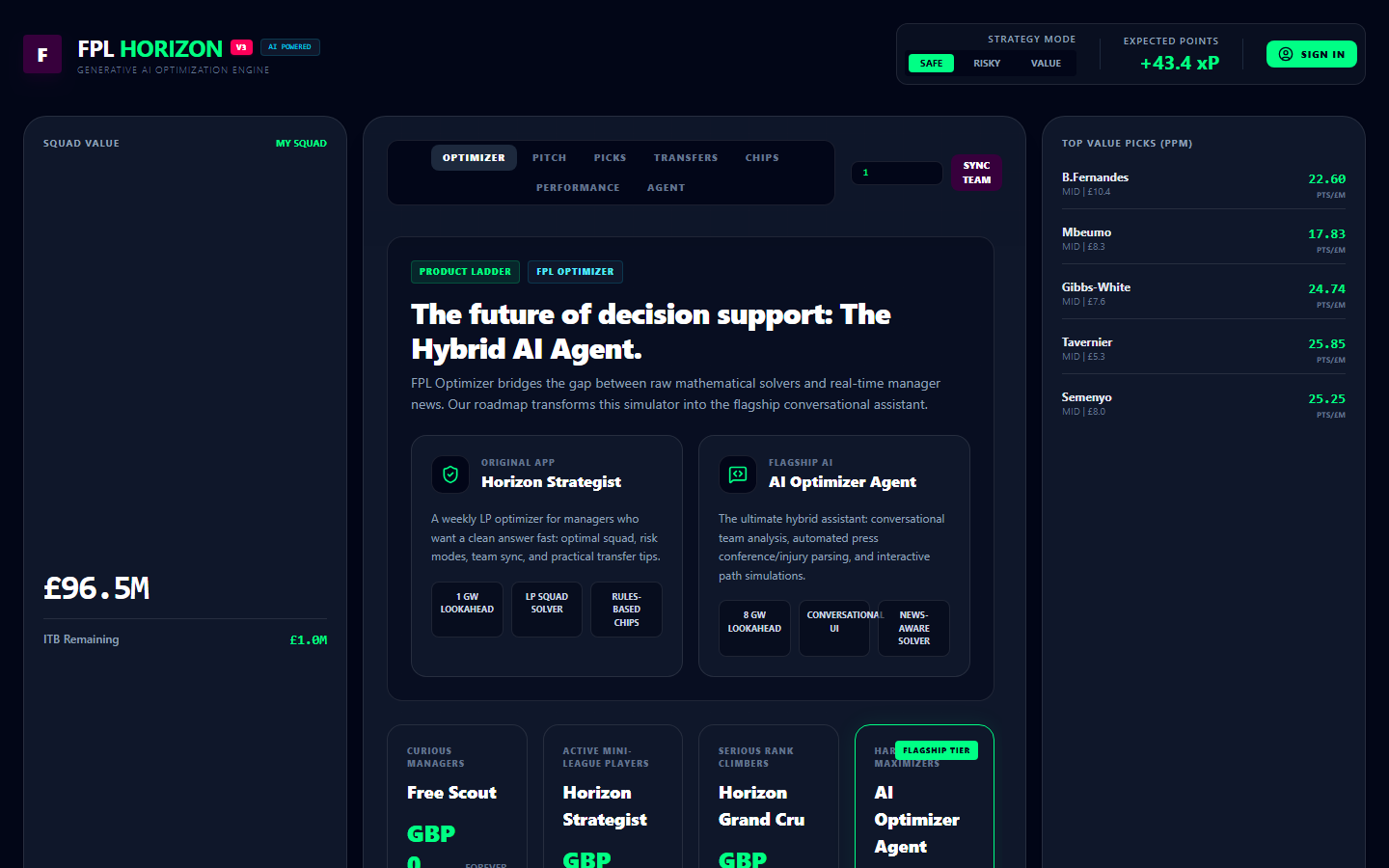
Get access to live expected value models, risk-adjusted constraints, and the only multi-horizon transfer planner powered by true Linear Programming.
Launch App at fplhorizon.app